Best Time to Paint an Exterior in Vancouver: Weather Windows That Actually Work
In Vancouver, the best exterior painting window is late spring through early fall, with the most reliable stretch usually June through September. The real trick is not picking a month. It is picking a forecast window where surfaces can fully dry, coatings can cure, and evening dew will not soak uncured paint.
- The Vancouver-specific weather patterns that make exteriors succeed or fail.
- Exact go or no-go thresholds for temperature, humidity, dew, and rain timing.
- A simple “weather window scorecard” you can use with any forecast app.
- How different siding materials change the waiting time after rain.
- How pros schedule prep, priming, and topcoats around coastal weather.
 Free exterior estimate
Want your exterior done in the best weather window?
We book Vancouver exterior painting around real forecast windows, with prep and protection built in so you are not gambling on the first sunny day.
Quick answer: the weather window that actually works
Vancouver is a mild coastal city, but it is also a high-humidity, rain-prone environment for much of the year. Exterior paint fails here for predictable reasons: painting over damp substrates, painting too late in the day, and getting surprised by overnight dew. The best time to paint is when you can satisfy four conditions at once for long enough to complete your prep, priming, and topcoats.
| Condition | Target | Why it matters in Vancouver |
|---|---|---|
| Temperature | Ideally 10°C to 25°C during application, and nights that stay mild. | Late-day temperature drops can stop proper film formation and increase the risk of moisture issues when dew forms after sunset. |
| Rain-free time | Enough time for each coat to dry and resist rain, plus extra buffer. | Coastal forecasts can shift quickly. You want margin so you are not repainting bubbled or stained areas. |
| Humidity and dew point | A surface temperature that stays safely above the dew point. | Even in summer, Vancouver can get evening marine air that pushes dew onto siding and trim. |
| Dry substrate | Wood and masonry must dry back fully after rain or washing. | Our winter and spring rains can leave cedar, stucco, and end grain holding moisture long after the sky clears. |
Month-by-month: Vancouver exterior painting season (with real rainfall context)
Here is the practical seasonal pattern homeowners experience: Vancouver winters and late fall are wet, spring is mixed, and summer is the most consistent. The data backs that up. Climate normals for Vancouver Harbour show average monthly precipitation around 236.6 mm in January and 245.2 mm in November, while July averages 43.5 mm and August averages 48.6 mm. That swing is why most professional exterior schedules cluster into late spring and summer.
| Month | Typical feel | Plan for | Why it helps or hurts |
|---|---|---|---|
| March | Still unsettled | Exterior quotes, repairs, prep | Wet cycles make it hard to keep wood and stucco dry long enough for full cure. |
| April | First usable breaks | Smaller jobs, sheltered sides | Afternoons can be workable, but cool nights and surprise showers are common. |
| May | Shoulder season sweet spot | Start full exteriors when forecast aligns | Longer days and warming temps, but you still need to respect evening dew. |
| June | More stable | Prime and topcoat without rushing | Great month for prep-heavy projects, especially on shaded north elevations. |
| July | Most reliable | Full exteriors, stains, major prep | Lowest average rainfall and the easiest cure conditions. |
| August | Reliable with hotter spikes | Chase shade around the house | Hot sun can flash-dry paint on dark walls, creating lap marks if you do not plan. |
| September | Excellent if early | Finish coats, touch ups | Often stable, but nights cool down and dew risk rises near the end of the month. |
| October | Risky | Only if forecasts are unusually dry | Rain returns and temperatures drop, which can stall coalescence and invite staining. |
| November to February | Mostly no-go | Planning, carpentry, interior work | Frequent rain and long damp periods can trap moisture in substrates and shorten coating life. |
Vancouver’s average daily max temperature climbs from about 13.9°C in April to around 23.0°C in July and August, which sits right in the comfortable zone for most exterior coatings. Those mild summer temperatures are a big reason exterior paint can last well here, as long as it is applied on dry surfaces and allowed to cure properly.
The four rules of exterior painting weather in Vancouver
If you remember nothing else, remember this: paint performance depends on the entire drying and curing period, not just the moment you roll it on. In coastal climates, the conditions later in the day and overnight are often the real deciding factor.
Rule 1: Respect the label and the technical data sheet
Different products have different minimums, and “paint” is not one thing. Modern acrylics can sometimes tolerate lower temperatures than older formulas, but the safest approach is to follow the specific product guidance and build a buffer. Manufacturers also remind you to consider air, surface, and material temperature, because a shaded wall can be colder than the forecast suggests.
Rule 2: Use a rain buffer, not a rain guess
Some premium exterior products can resist rain a few hours after application, but that does not mean you should plan that tightly. In Vancouver, wind shifts and marine air can turn “no rain” into drizzle. Your goal is to avoid water contact while the film is vulnerable and while the substrate is still releasing moisture.
Rule 3: Dew is rain you did not see coming
Dew forms when surfaces cool toward the dew point after sunset. If your paint is still curing, that moisture can seep into the film and create staining, adhesion problems, and early failure. This is why “warm day, cold night” patterns are dangerous.
Rule 4: Dry substrate first, then paint
Vancouver homes often have cedar, fiber cement, stucco, and lots of trim details. Many of those materials can hold moisture after rain or pressure washing. Painting too soon locks that moisture in, and the coating fails from the inside out.
Dew and overnight temperatures: Vancouver’s silent failure mode
Homeowners often check a forecast once, see a sunny day, and assume it is painting weather. But professionals watch the evening and early morning conditions because that is when dew and cool substrate temperatures create trouble.
A practical way to think about it is: you want to finish painting early enough in the day that the coating is no longer vulnerable by the time the air cools and moisture begins to condense. Many painters in Vancouver aim to paint after the morning has dried off, then stop early enough to avoid chasing wet edges into the evening.
How to spot a dew-risk day
- Clear skies at night after a warm day. Surfaces radiate heat and cool quickly.
- Light winds in the evening. Moist air sits instead of mixing out.
- Marine air drifting in from the water, especially in West Vancouver, Kits, Point Grey, and the North Shore.
- Shaded elevations under trees or close to neighboring homes. They cool faster and stay damp longer.
The “surface temperature above dew point” rule
Manufacturers and coating professionals often use a simple safety margin: paint only when the surface temperature is meaningfully above the dew point. Benjamin Moore notes an industry standard of painting on a surface whose temperature is more than 5°F above the dew point, and many professional product sheets include similar guidance. This is why infrared thermometers and basic weather meters can be useful for tricky sites.
Rain, soak time, and dry-back: how long to wait after rain in Vancouver
In Vancouver, “it stopped raining” is not the same as “it is ready for paint.” You need the surface to be dry, and you need moisture inside the substrate to drop low enough that it will not push outward after you coat it. Sherwin-Williams notes that wood and masonry absorb more moisture than aluminum or vinyl, and recommends at least a day after heavy rain, while still emphasizing the surface must be dry.
| Surface | How it behaves | Typical wait after heavy rain | What to check |
|---|---|---|---|
| Cedar or wood siding | Absorbs water, especially at end grain, joints, and near gutters. | Often 24 to 48 hours, longer for shaded sides. | Touch test on shaded areas, check joints, and use a moisture meter if you can. |
| Stucco and masonry | Can hold moisture deep in pores, then release slowly. | Often 48 to 72 hours after soaking rain. | Look for dark patches, cool damp feel, and slow drying in corners. |
| Fiber cement | More stable than wood, but can trap water at seams and edges. | Often 24 to 48 hours. | Check seams, caulk lines, and back side of lap joints. |
| Aluminum or vinyl | Does not absorb water, but can hold surface moisture and soap residue after washing. | Often dry same day if sun and airflow cooperate. | Confirm no chalking residue, rinse thoroughly, and let it dry fully before painting. |
| Trim, fascia, and soffits | Lots of edges and joints, often shaded, often where water runs. | Typically longer than the wall. | Check underside edges, knots, and caulked seams. |
Pressure washing is a similar story. Washing is important because it removes contaminants that ruin adhesion, but it also introduces water. In Vancouver, pros often pressure wash early, then spend the next day or two on scraping, sanding, repairs, and masking while the structure dries back. That “prep day buffer” is part of why professional scheduling works better than “paint tomorrow if it is sunny.”
Sun, shade, wind, and coastal salt: the microclimate factors that change your plan
Direct sun can be too hot even when the air is mild
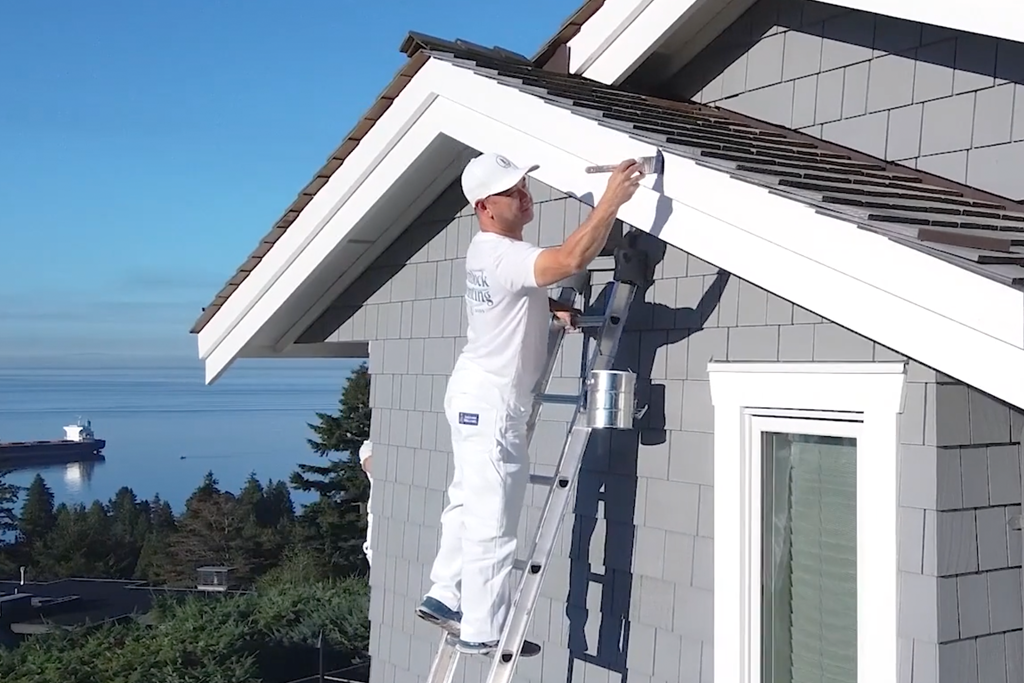
Vancouver does not get the same prolonged heat as some interior regions, but dark siding in direct sun can still get much hotter than the air temperature. Manufacturers advise avoiding direct sunlight because the surface temperature can rise and paint can dry too quickly, leading to lap marks, brush marks, or adhesion problems. The practical fix is simple: follow the shade around the home. Start on the east side after the morning dries off, move south as needed, and save the west wall for later when it is shaded.
Wind is both friend and enemy
A light breeze helps drying. Strong wind can blow debris into wet paint, increase overspray risk, and make cutting crisp lines harder. If your home is exposed, plan for more masking and choose application methods that match the conditions.
Salt air and shaded mildew zones
Homes near the water and homes tucked under trees have two extra challenges: salt deposition and persistent organic growth. If you see green or black staining, you need proper cleaning and the right primers or additives. Painting over mildew is a guarantee it returns through the finish.
How to plan a Vancouver exterior painting window (scorecard + checklist)
Use this planning approach and you will avoid most of the expensive mistakes. It is designed for Vancouver’s climate, but it applies to any wet coastal market.
Step 1: Pick the project type and how many “coating days” you need
- Touch ups or one elevation: 1 to 2 days.
- Trim heavy repaint: 3 to 5 days.
- Full exterior with scraping and repairs: 5 to 10 days depending on access and condition.
Remember that prep has weather requirements too. Caulking and primers have their own cure needs. If you only plan for “painting days,” you will feel forced to cut corners when the forecast changes.
Step 2: Use the Weather Window Scorecard
Weather Window Scorecard (use this with any 7-day forecast)
- Daytime temperature: Is it within the product range and comfortable, ideally around 10°C to 25°C?
- Night temperatures: Do nights stay mild enough that paint will keep forming a film, and will you avoid heavy dew?
- Rain timing: Do you have enough dry hours after each coat, plus buffer for forecast error?
- Humidity trend: Is the humidity staying reasonable in the afternoon, not spiking into heavy evening dampness?
- Wind: Is it calm enough to cut clean lines and avoid debris, especially if spraying?
- Surface dry-back: Has the home had time to dry after rain or washing, especially on shaded elevations?
- Sun exposure: Can you plan your work to avoid painting in direct hot sun on dark colors?
If you fail any one category badly, treat it as a no-go day. Vancouver failures usually happen when people ignore night conditions and surface dry-back.
Step 3: Use the 48-hour Go or No-Go checklist
48-hour checklist before you paint
- Walk the shaded sides and touch the siding and trim. If it feels cool and damp, wait.
- Look at the forecast for the entire cure window, not just the morning you plan to start.
- Confirm you can stop early enough to avoid painting into evening dew.
- Confirm gutters are not overflowing and downspouts are not soaking the wall.
- Identify problem zones: near grade, behind shrubs, under eaves, and on north-facing walls.
- Stage materials so paint is at a reasonable temperature. Cold paint out of a garage can behave poorly.
Step 4: Build a schedule that is not fragile
The schedule that survives Vancouver weather is one that separates the job into logical chunks: cleaning and protection, prep and repairs, priming, then finish coats. If you compress everything into a single “sunny weekend,” you lose the flexibility to stop when conditions shift.
Schedule your best windowWe can quote now, then paint when the window is real
Our estimating process measures the job on-site and builds the plan around Vancouver’s reality: prep time, drying time, and weather buffers.
What we see in Vancouver homes (and how professionals prevent problems)
Vancouver exteriors rarely fail because “the paint was bad.” They fail because moisture and contamination were not handled, or because the day ended colder and wetter than expected. Here are the most common patterns we see on real homes in the Lower Mainland, and the fixes that keep finishes durable.
Failure pattern 1: Painting over damp cedar or damp end grain
Cedar is beautiful and common in Vancouver, but it absorbs moisture readily. End grain at the bottom of boards and near trim details can hold water long after a rain. Professionals counter this by scraping loose paint, sanding, priming bare wood properly, and letting surfaces dry fully before topcoating.
Failure pattern 2: Mildew and organic staining that comes back fast
Shaded north elevations, areas behind shrubs, and walls near grade are mildew magnets. Painting over it traps the spores under a new film. The right approach is cleaning with appropriate solutions, thorough rinsing, and allowing dry-back. When you repaint, use coatings designed for exterior durability and keep airflow in mind.
Failure pattern 3: Lap marks and flashing on sunny walls
On warm days, especially on dark colors, paint can dry too fast on the surface and leave lap marks where wet edges overlap. Avoid direct sunlight and work in manageable sections, keeping a consistent wet edge. If you are spraying, back rolling helps even out absorption and texture on porous surfaces.
Failure pattern 4: Caulk that splits within a year
Caulk is part of weatherproofing, but it must be applied in suitable conditions and given time to cure. Cheap caulk and rushed application are common DIY pitfalls. Use exterior-grade products, follow cure times, and do not paint over uncured caulk in cold, damp conditions.
Failure pattern 5: Peeling near gutters, hose bibs, and deck connections
These are the hidden water sources that keep walls damp: leaking gutters, splashback from decks, and slow drips from hoses. Painting without fixing the moisture source is a temporary cosmetic patch. A good estimate includes identifying these zones so the paint system can actually last.
FAQ: best time to paint exteriors in Vancouver
Can you paint an exterior in Vancouver in April?
Sometimes. April can have usable afternoon windows, but nights are still cool and rain systems are frequent. Treat April as a shoulder-season month: focus on sheltered elevations, smaller scopes, and only commit to full exteriors when the forecast shows multiple dry days and mild nights.
Is summer always the best time, or can it be too hot?
Summer is usually the easiest, but direct sun on dark siding can make surface temperatures much hotter than the air. That can cause paint to dry too quickly and leave lap marks. Plan your sequence around shade and avoid painting in harsh afternoon sun on west walls.
How long after rain should I wait before painting?
It depends on the material and exposure. Wood and masonry absorb moisture and can require at least a day after heavy rain, and often longer on shaded sides. Vinyl and aluminum dry faster but still need to be clean and fully dry. When in doubt, wait and verify dryness in the most shaded, slowest-drying areas.
What temperature is too cold for exterior painting?
Many products struggle when temperatures drop and paint cannot properly form a film. Nighttime lows matter as much as daytime highs because the coating continues to cure. Follow the product data sheet, plan for mild nights, and avoid painting late in the day when temperatures will fall quickly.
What humidity is too high to paint outside?
High humidity slows drying and increases the risk of moisture forming on surfaces. Rather than chasing a single percentage number, focus on dew risk: if the surface temperature is too close to the dew point, moisture can condense and disrupt curing.
What time of day should you paint an exterior in Vancouver?
Often the best window is late morning through mid-afternoon. Morning dew needs time to evaporate, and late-day painting can run into evening moisture and temperature drops. A common pro approach is to start after the exterior is fully dry and stop early enough that coats are not vulnerable overnight.
Can you paint in the shade or on the north side?
Yes, and it is often safer in summer because you avoid hot sun. The tradeoff is that shade dries slower and can stay damp longer after rain. Give shaded elevations extra dry-back time and plan coats around the most stable part of the day.
Should I book painters months in advance for Vancouver summer?
Usually yes. Summer is the most popular season for exterior work, and crews schedule around forecast windows. Booking early gives you better choice of dates and more flexibility to shift when weather changes.
Related guides for Vancouver homeowners
Ready when the weather isGet a plan that fits Vancouver’s exterior season
Request an estimate now, then we will schedule your project for the best forecast window so the finish cures properly and lasts.
Phone: 604 250 2561
Disclaimer: Always follow the specific product label and technical data sheet for the paint system you choose. Conditions vary by site, elevation, shade, and surface type.